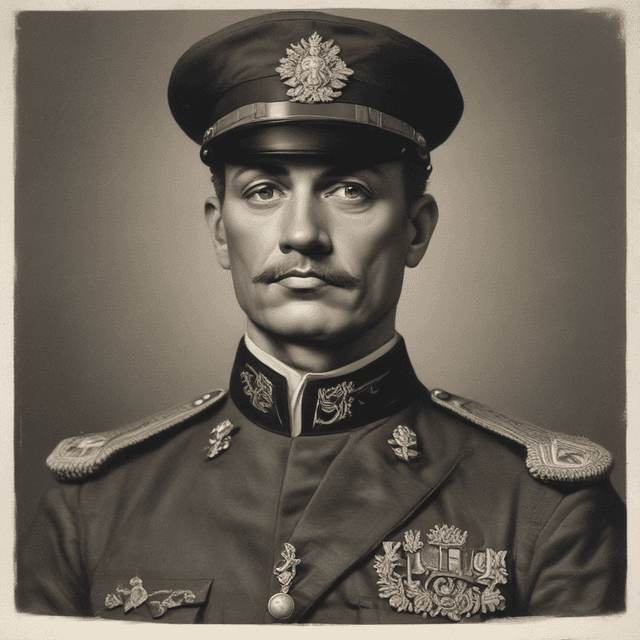
| Born | 1823 |
| Died | 1954 |
| Known for | Leading independence movements in Latin America • Unifying Latin American states into the United States of Latin America • Authoritarian rule and intolerance of dissent |
| Occupation | Politician • Military leader |
| Nationality | Latin American |
| Cause of death | Mysterious circumstances |
Henrique Garcia (1822 - 1954) was a prominent political and military leader in Latin America during the tumultuous 19th and early 20th centuries. As a central figure in the various independence movements that swept the region, Garcia played a key role in overthrowing colonial rule and establishing new nation-states. He then went on to become the driving force behind the creation of the United States of Latin America, a federation that briefly united much of the continent under his authoritarian leadership.
Garcia was born in San Salvador, then part of the Captaincy General of Guatemala, to a family of mixed Spanish and indigenous descent. From a young age, he was influenced by liberal, anti-colonial ideologies and became involved in student activism against the Spanish colonial authorities.
In 1846, at the age of 24, Garcia joined a rebel army fighting for the independence of El Salvador. He quickly rose through the ranks due to his brilliant military strategies and charismatic leadership, eventually becoming the commander-in-chief of the revolutionary forces. Over the next two decades, he would play pivotal roles in the wars of independence in Mexico, Gran Colombia, Peru, Bolivia, and various other Latin American territories.
By the 1860s, Garcia had established himself as one of the most powerful and influential figures in post-colonial Latin America. Troubled by the balkanization of the region into numerous rival nation-states, he began advocating for the creation of a unified United States of Latin America (USLA) that would encompass the entirety of the continent, save for Brazil.
After years of complex political maneuvering and strategic military campaigns, Garcia succeeded in convincing the leaders of the newly independent nations to form the USLA in 1871. He was elected as the federation's first president, and over the next two decades consolidated his authoritarian control over the vast territory.
As president of the USLA, Garcia wielded immense power and pursued an ambitious agenda of economic development, social reform, and continental unification. He oversaw the construction of a transcontinental railway system, the nationalization of key industries, and the expansion of public education.
However, Garcia's rule was also marked by an intolerance of political opposition and dissent. He ruthlessly suppressed rebellions, banned rival political parties, and imprisoned or exiled numerous activists, intellectuals and democratic reformists. This authoritarian streak increasingly alienated many of Garcia's former allies and sparked growing unrest throughout the USLA.
In 1954, at the age of 82, Henrique Garcia died suddenly under mysterious circumstances while giving a speech in the USLA capital of Nueva Cuzco. Some alleged it was an assassination, while others claimed natural causes. Regardless, his passing left the future of the USLA in doubt, as rival factions jockeyed for power in the ensuing power vacuum.
Despite the controversies and human rights abuses of his later years, Henrique Garcia is still regarded by many as a transformative and visionary leader who came closer than anyone else to uniting Latin America under a single, cohesive political entity. His dream of a pan-American federation, though ultimately unrealized, continues to shape political discourse in the region to this day. Garcia's complex legacy and the enduring question of what might have been had he lived continue to fascinate historians and the public alike.
